The world’s first unmanned aerial vehicle (UAV) with ultra-high molecular weight polyethylene (UHMWPE) fiber-reinforced composite as its primary load-bearing structure recently completed a successful maiden flight test under the leadership of XINGI TECH Co., Ltd. This marks the first application of UHMWPE fiber in the primary load-bearing structure of an aircraft, filling a global gap for the material in the aviation field.
During the maiden flight test, the UAV took off smoothly, flew steadily, and landed precisely, with all flight indicators meeting design expectations. Through five years of research and development, XINGI TECH overcame core technical challenges in UHMWPE fiber interfacial bonding, molding processes, and structural design, built a complete technical barrier, and achieved an industrial upgrade from single fiber products to aviation composites.
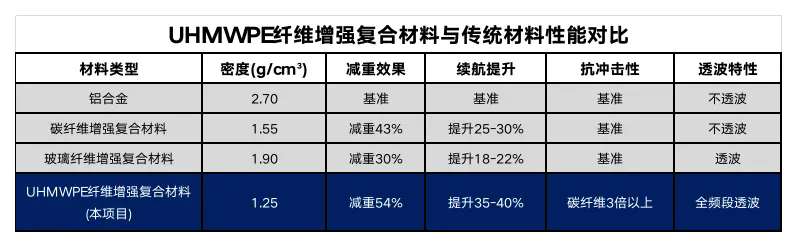
Figure: Performance comparison between UHMWPE fiber-reinforced composite and conventional materials
XINGI TECH’s UHMWPE fiber-reinforced composite demonstrates significant technical advantages in multiple dimensions:
1. Weight reduction breakthrough: redefining the lightweight standard for aviation materials
UHMWPE fiber-reinforced composite has a density of only 1.2-1.3 g/cm³, more than 52% lighter than conventional aviation aluminum alloy (2.7 g/cm³), more than 35% lighter than glass fiber composite (1.8-2.1 g/cm³), and more than 22% lighter than carbon fiber composite (1.5-1.6 g/cm³). At equal volume, its weight is nearly halved, laying a solid foundation for a leap in UAV endurance.
2. Longer endurance: a leap in range brought by lighter materials
The UAV field follows the technical principle that “lighter weight means longer range.” Taking a mainstream industrial UAV with a 5 kg payload and a 20 km range as an example, under the same battery capacity and payload, adopting UHMWPE fiber-reinforced composite increases endurance by 35%-40% compared with aluminum alloy, 20%-25% compared with glass fiber composite, and 15%-20% compared with carbon fiber composite. Endurance is significantly enhanced and operating efficiency greatly improved.
3. Both strong and tough: overcoming the technical contradiction between “light” and “tough”
Carbon fiber composite is strong but brittle, prone to fracture in drops and collisions and difficult to repair, while aluminum alloy is tough but relatively heavy. UHMWPE fiber-reinforced composite effectively unifies “light” and “tough”: its flexural strength falls within the performance range of carbon fiber composite, its impact resistance is more than three times that of carbon fiber composite, and it offers high damage tolerance and does not fracture brittlely under impact, demonstrating excellent overall performance.
4. Wave-transparent properties: a structural material with full-band electromagnetic compatibility
Both carbon fiber and aluminum alloy are conductors that shield electromagnetic waves and interfere with the transmission of signals such as GPS and 5G. UHMWPE fiber-reinforced composite offers excellent insulation properties and full-band wave transparency, allowing GPS, 5G, data transmission, and video transmission signals to pass through without loss. No additional antenna cutouts are needed, the structure remains more complete, and a new technical path is provided for the design of UAV communication systems.
5. Future applications: extending the technology from UAVs to advanced equipment
The latest national defense research results from 2025 show that UHMWPE-based composite combines excellent electromagnetic compatibility with extremely high ballistic impact resistance across the ultra-wide 3.5 GHz-35 GHz band. The material requires no additional radar-absorbing coating and integrates lightweight, high strength, impact resistance, and wave transparency in one, providing new material technology reserves for advanced equipment such as sixth-generation fighter aircraft.
The successful maiden flight verified the feasibility of UHMWPE fiber-reinforced composite for the primary load-bearing structure of an aircraft and laid the foundation for the large-scale application of the material in aviation. In the future, XINGI TECH will continue to deepen the research, development, and application of UHMWPE fiber-reinforced composite in aviation, aerospace, and other fields, extending new material technology to more application scenarios.