
Abstract: Lightweighting is one of the key requirements for ballistic protection equipment, calling for protective materials with a series of advantages such as low mass and high specific strength and specific modulus, and it has attracted increasing attention. This paper mainly introduces the classification of high-performance lightweight ballistic materials and compares the lightweight transparent armor and add-on composite armor of ballistic vehicles with existing materials, providing ideas for subsequent product development.
Keywords: lightweighting; transparent armor; add-on composite armor
1 Introduction
Traditional ballistic materials mostly use ballistic steel plate and achieve protection by increasing material thickness or stacking layers, which places a heavy weight burden on armored equipment and constrains the effective use of tactics and strategy. Weight is one of the main factors affecting the battlefield responsiveness of armored equipment. Modern high-tech warfare places extremely stringent requirements on the weight indicators of armored equipment, namely lightweighting, high performance and high mobility and flexibility while satisfying high ballistic resistance. The emergence of high-performance lightweight ballistic materials solves this problem: non-metallic composites reduce the thickness of ballistic steel plate, effectively lowering the curb weight of ballistic vehicles and achieving the goal of lightweighting. Studies have shown that the bulk density of high-performance fiber ballistic composites is generally 0.9~2.0 g/cm3, only 1/8 to 1/4 that of ballistic steel, while their specific modulus is 3~5 times and their specific strength 4~10 times that of ballistic steel. Therefore, using high-performance fiber ballistic composites for vehicle protection can greatly reduce weight, or provide higher ballistic protection at the same weight [1]. Compared with the ballistic steel plate commonly used in ballistic vehicles, these composites feature light weight and good processability at an equivalent level of ballistic protection. Today, high-performance composite ballistic materials are produced by combining multiple materials or adding functional fillers, and structural lightweighting with improved ballistic performance is achieved by adjusting material composition and ratios and optimizing structural design. This is an important part of modern ballistic materials research.
Many review articles at home and abroad introduce ballistic materials and their state of development from different perspectives, such as comparative introductions of the performance of several ballistic materials [2,3], the development of high-performance ballistic materials [4,5], factors influencing the design and material selection of ballistic materials [6], or analyses of the impact process of materials [7,8]. This paper compares and analyses the classification of lightweight ballistic materials and the lightweight transparent armor and add-on composite armor of armored vehicles, providing ideas for product development.
2 Ballistic Mechanisms of Lightweight Ballistic Materials
Lightweight ballistic materials mainly include ceramic plate ballistic materials, high-performance fiber composite ballistic materials and composite ballistic materials. Ceramic ballistic materials mainly use their own strength and hardness to blunt and destroy the projectile and deflect the fragments in order to stop it; the ballistic mechanism of soft ballistic materials based on high-performance fibers is that, when the projectile stretches and shears the fibers, the impact energy is absorbed and dissipated, or propagates and disperses along the fibers away from the impact point, by changing the fabric structure and breaking fibers, thus achieving protection; composite ballistic materials, through the layered design and combination of multiple materials, allow the advantages of each component to complement one another. Such materials can not only absorb or disperse all the impact energy, but also prevent material deformation caused by violent projectile impact from injuring personnel or damaging the internal structure of armored vehicles, minimizing the damage caused by the projectile.
3 Classification of Lightweight Ballistic Materials
3.1 Ceramic Plate Ballistic Materials
Ceramic plate materials have extremely high hardness and elastic modulus, lower density than metals, good chemical stability, and resistance to high temperature, impact and wear. They can withstand the erosion of high-velocity armor-piercing projectiles while reducing armor mass; used as a sandwich plate combined with steel plate, their ballistic performance even exceeds twice that of homogeneous steel armor of the same thickness, and such composite ballistic materials have been widely used in light armored vehicles.
3.2 High-Performance Fiber Composite Plate Ballistic Materials
High-performance fiber composite plate ballistic materials are made by combining one or more high-performance fiber fabrics or their plies with a resin matrix under certain process conditions to obtain materials with a certain ballistic performance. High-performance fibers have excellent physical and chemical properties, such as low density, high specific strength and specific modulus, appropriate elongation at break and good corrosion resistance. Ballistic products made from high-performance fibers are not only light in weight and good in flexibility, but also highly designable and simple to form; the high-performance fibers widely used today mainly include glass fiber, carbon fiber, aramid and UHMWPE, and they can be used for the inner wall linings of attack helicopters and armored fighting vehicles with excellent protective effects.
3.3 Composite Ballistic Materials
Requirements for high impact resistance, low weight, comfort and durability and other special protective properties of ballistic materials are constantly escalating, and a single material can no longer fully meet application requirements. Combining two or more of the above materials into a multilayer composite ballistic material is a breakthrough point for research. The components of composite ballistic materials complement each other in performance and produce a synergistic effect, so that their overall performance is greatly improved relative to a single homogeneous material. For example, adding a ceramic face plate to steel armor can significantly reduce the penetration, blunting and fragmentation energy of the projectile and, while reducing structural mass by 25%, can increase the energy absorption per unit area of the impact plate by more than 35%.
4 Comparison of Lightweighting Applications in Ballistic Armor
4.1 Transparent Ballistic Armor
4.1.1 Rigid ballistic glass is usually borosilicate glass
It is resistant to high temperature, high pressure and corrosion, has high mechanical strength and a low thermal expansion coefficient, is easy to heat-treat, can withstand large impact forces and does not break easily.
4.1.2 Transparent ceramics are produced by deliberately adding small amounts of metals or compounds to the glass raw material
(such as gold, silver, copper, platinum and titanium dioxide) as crystallization nuclei; after the glass is melted and formed, it is irradiated with short-wavelength radiation (such as ultraviolet or X-rays) or heat-treated, so that the crystallization nuclei in the glass become active, gather together and grow into many tiny crystals, thus producing glass-ceramics. Transparent ceramics have very high mechanical strength and hardness and can withstand very high temperatures.
4.1.3 Add-On Transparent Armor
Add-on transparent armor comprises two transparent plastic plates and a transparent crystal layer sandwiched between them. It is detachably fixed to ballistic glass, making it easy to change the protection level of the original armored equipment; at the same time, the transparent crystals are sandwiched between the two transparent plastic plates in a tiled manner, and the plastic plates serve as backing plates for the transparent crystal layer. This overcomes the disadvantage that small transparent crystals cannot match product dimensions and shapes and, by making use of the ballistic properties of the crystal, yields add-on transparent armor with good ballistic performance.
4.1.4 Comparative Analysis
Rigid ballistic glass achieves a 10%~20% weight reduction compared with GCP ballistic glass, while transparent ceramic armor achieves a weight reduction of 60%. See Table 1:
Table 1 Weight reduction comparison of transparent armor
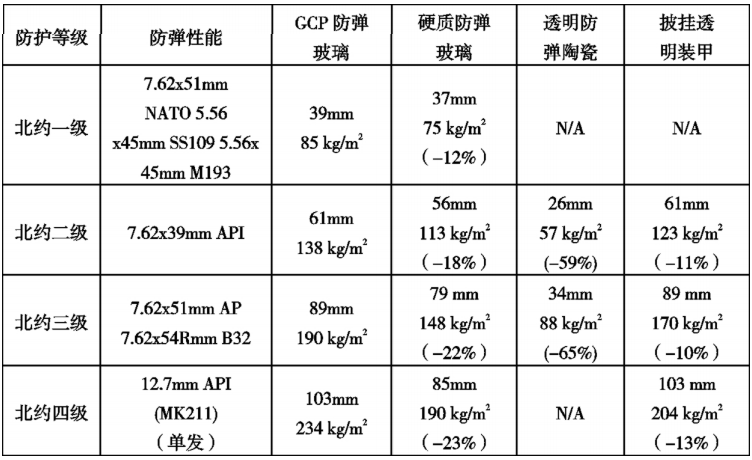
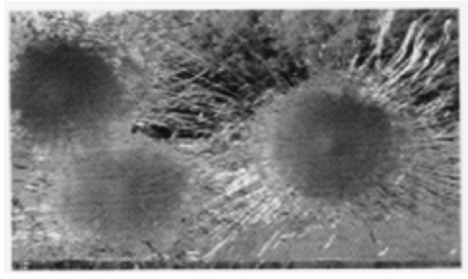
Figure 1 Bullet impact effect on GCP ballistic glass
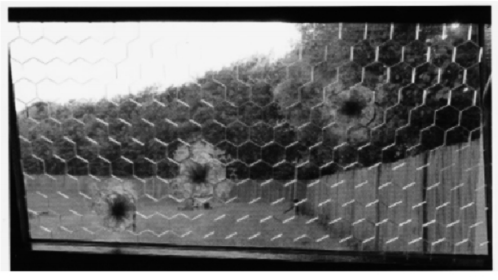
Figure 2 Bullet impact effect on transparent ceramics
Transparent ceramics show a small damaged area after bullet impact and little effect on the view inside the vehicle; the post-impact effects are shown in Figures 1 and 2.
4.2 Add-On Composite Armor
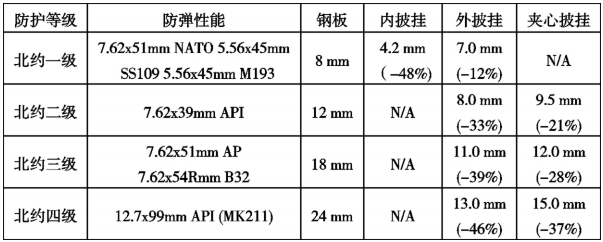
There are three ways of combining steel plate (ballistic steel plate or high-strength steel plate) with non-metallic materials to achieve the lightest possible add-on armor:
1) Internal add-on: high-performance composite ballistic material attached to the inner side of the steel plate (ballistic steel plate or high-strength steel plate);
2) External add-on: high-performance composite ballistic material attached to the outer side of the steel plate (ballistic steel plate or high-strength steel plate);
3) Sandwich add-on: high-performance composite ballistic material attached to both the inner and outer sides of the steel plate (ballistic steel plate or high-strength steel plate).
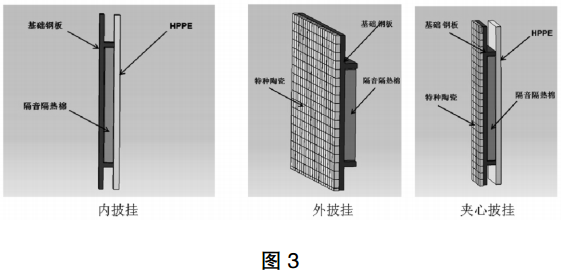
Table 2 Weight reduction comparison of add-on armor
5 Conclusion
With advances in science and technology, modern high-performance ballistic materials have developed toward light weight, comfort, low cost, multifunctionality and high performance, providing users with increasingly reliable safety protection. Future research should cover both the improvement of traditional materials and the study of new ballistic materials, combining new high-performance materials with traditional materials so that their advantages complement each other and products become lighter.
References
[1] Zuo Xiangchun et al. Current status of ballistic UD fabric composites [J]. Fiber Reinforced Plastics/Composites, 2010(5).
[2] Han Hui, Li Jun, et al. Research on the application of ceramic-metal composites in the ballistic protection field [J]. Materials Review, 2007, 21(2):34.
[3] Zhong Weihong, Zhang Zuoguang, et al. A new ballistic material — UHMWPE fiber [J]. Ordnance Material Science and Engineering, 1995, 18(5):60.
[4] Wei Zhongren, Du Wenze, et al. Research progress of aramid fiber ballistic composites [J]. Engineering Plastics Application, 2009, 37(1):75.
[5] Zheng Zhen, Yang Nianci, et al. Research progress of rigid ballistic fiber composites [J]. Journal of Materials Science and Engineering, 2005, 23(6):905.
[6] Grujicie M, Bell W C, et al.Design and material selection guidelinesand strategies for transparent armor systems[J].Mater Des, 2012, 34:808.
[7] Appleby-Thomas G J, Hazell P J, et al.Shock propagation in a cemen-ted tungsten carbide [J].J Appl Phys, 2009, 105(6):064916.
[8] Richardon MOW, Wisheart M J. Review of low-velocity impactpropertites of composite materials[J].Composites:Part A, 1996, 27(12):1123.